“The Danger of a Single Story”

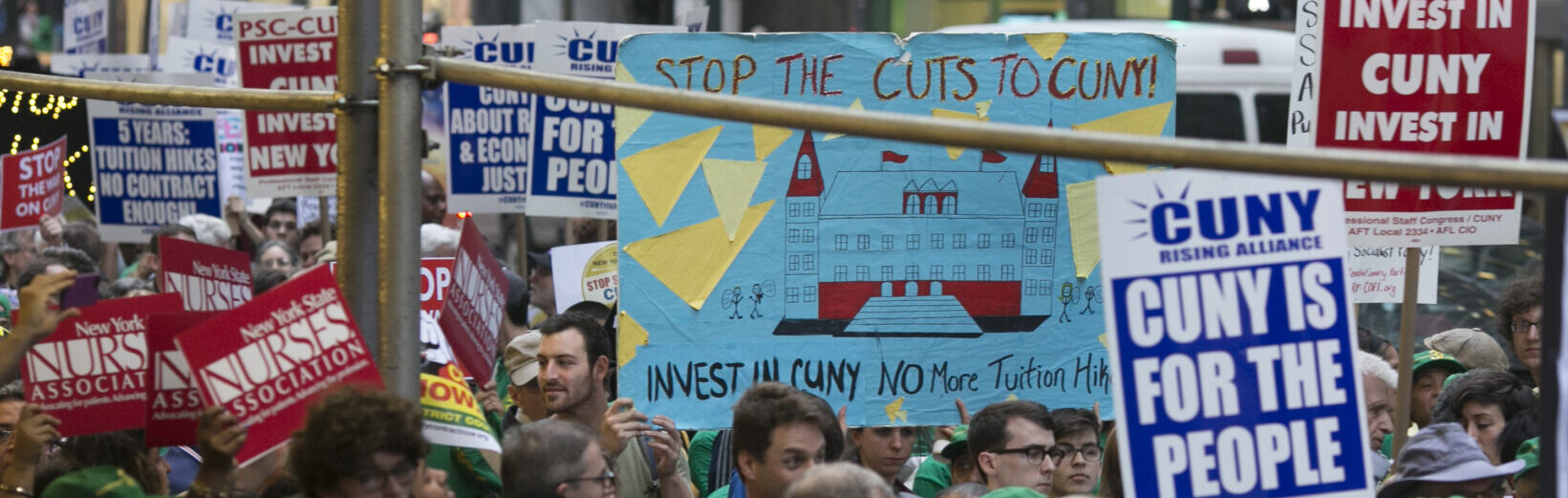
Dr. Cottom makes a crucial point about people viewing education as inherently and exceptionally good, even when the education system has consistently failed them at every turn. I see this as being detrimental for two reasons. The first reason is that it renders the harms caused by education invisible, for example it can make it difficult to see CUNY (and “the university”—a term I hope we will grapple with this semester) as a Carceral space not an exceptional site located outside of antiblack policing. The second reason is that it makes education into a panacea which it is not—education should exist alongside housing, public health, the arts, etc. I worry that some of the positive framing of CUNY in relation to COVID, for example the superherofication of the frontline worker / CUNY student, or the longer standing focus on CUNY as an engine of social mobility hold the university to impossibly high (and perhaps not optimal) standards that can have adverse ramifications. Do CUNY students working in healthcare and food service need to die en masse so that the city’s wealthy residents can survive COVID in relative comfort for the university to warrant funding? Does CUNY need to be the horario Alger industrial complex to earn its keep in Albany? 

In her talk at the Graduate Center a couple months back, Dr. Cottom expressed frustration with a common misreading of her book that saw it as solely focused on for-profit universities as unique spaces within higher ed, missing the larger claim she is making about the pervasiveness of lower ed across the higher education sector. I see this as connected to a larger critique of the classification systems of colleges and universities that often obscure significant differences, even when they are attempting to reveal differences themselves. For example, in response to an overwhelming focus on private institutions in the media (the NYT seems to think Harvard is the only university in the world) much of the CUNY narrative demands greater attention be paid to public universities. But there is enormous variance within public higher education, with Berkeley certainly failing to speak adequately to the realities of Grambling State. Community colleges, which educate around half of the nation’s students, are given little attention in the media and even less that takes into account difference within this enormous sector. CUNY, the largest urban public university in the nation with hundreds of thousands of students and dozens of colleges and schools, is similarly depicted as a monolith, even in the op-eds written by those affiliated with CUNY. This can make it difficult to see that while we certainly experience austerity at the Grad Center (as the recent cuts to graduate students funding make clear), it is not to the same degree as the organized abandonment of a college like Medgar Evers where students attend overenrolled courses in temporary trailers that have seemingly become permanent.   

Week 2 Response – Miguel Rodriguez

The readings all seem to land well for me, but this might be becasue I have been reading so many blogs, stories, articles, etcc.. on having to decide between people and money.

Some qoutes that stood out to me from the readings are

“College presidents and their boards have a seemingly impossible choice..” – College Choice

“At that moment, we hoped to complete our research projects, write our papers, and pass our last class before throwing our caps in the sky and celebrating with our class of 2020” – John Jay Project

“It seems likely that no other college has suffered any many deaths as CUNY” (Robin, 2020)

I am anchoring on a few ideas that are coming from the readings

  1. How capitalism is showing up in “Plans to re open”
  2. How money seems to be the motivating factor for a-lot of private/public institutions.
  3. Notions of academic mutual aid and what that might look like for CUNY.
  4. Are we prioritizing stopping death or keeping life?

I recently published an article this summer that I believe adds to this discourse of this weeks readings (see below)

https://www.tandfonline.com/doi/pdf/10.1080/02615479.2020.1825665?needAccess=true

Week 2 Responses: CUNY and COVID — DUE FEB 8

A prompt or series of questions can help focus your responses to our weekly readings. We encourage you to craft your own prompts and write them at the top of your responses, but we will also suggest prompts to you, as below.

CONTEXT QUESTIONS

  • What kind of texts did we read for today (Feb 9)? (note sources & their conventions)
  • Why begin our course with these kinds of academic writings? (consider teaching/learning context)
  • How are you located in relation to this mini-archive of readings? (name your perspective)

CONTENT QUESTIONS

  • What patterns (e.g., repeated terms, places, rhetorics) do you see across today’s readings? (analyze the data, i.e., remake the parts into a new whole)
  • What key tensions mark/motivate these writings? (set the stakes)
  • What critical frameworks help you engage with these writings, at least partially? (adopt/adapt a theory, methodology, or disciplinary viewpoint)

SITUATED/INFORMED RESPONSE

  • THE REAL QUESTION: What do you most want to say to our class in response to today’s readings, given your considerations of the prompts above?

Graduate Education at Work in the World, Feb 18-19, 2021. Collectively imagine and redesign graduate education to support students, scholarship, and the public good. Click to learn more.

Feb 18-19: Free conference! Graduate Education at Work in the World

Join the Futures Initiative and PublicsLab of the Graduate Center, CUNY for a free two-day conference and workshop: Graduate Education at Work in the World. The conference will bring together practitioners, students, faculty, and administrators to collectively imagine and redesign graduate education to support students, scholarship, and the public good.

This conference will focus on new approaches to graduate education in support of the public good, without losing sight of other key elements of higher education reform—including labor practices, student debt, efforts toward improving diversity and inclusion, shared governance, pedagogical training, and more. Participants will generate ideas, share best practices, consider difficult questions, and work toward new models for graduate education that support an array of creative, flexible career paths.

See the full program, and register here!

Critical Vocabulary around Equity, Elitism, and Public Higher Education

EQUITY: COVID, race, class, gender, fairness, equality, access, opportunity, level playing field, bias, diversity, decolonizing, debt, adjunctification, pipeline, Indigeneity, sustainability

ELITISM: COVID, hierarchy, selection, racism, meritocracy, class stratification, race sorting, ranking, tiers, structures, altac, tacit knowledge, lower ed, privileged poor, white supremacy, classism, ivy league, private,

PUBLIC HIGHER EDUCATION: COVID, CUNY, institutionalization, public good, community college, free college, Black university, critical university studies, austerity, queer studies

How to post your weekly responses

  1. Hover over “+New” at the top of the POSTS page, then select “Post.”
  2. Use the title: “YOUR NAME + title of response”
  3. Click in the “Start writing or type” block beneath the title. Paste your paragraph into this block.
  4. Click the blue “Publish” box at the top right (you will need to click “Publish” twice). You can “Preview” your post first if you’d like.
  5. The video below takes you through these steps (note: Matt originally created this demonstration for another class, but the steps are the same for ours).
